How to Properly Introduce Your Hunting Dog to Gunfire

Avoid Making a Gun-Shy Dog By Creating Confidence Through a Solid Foundation
By Tom Keer
When the front door to the bar opened it let in such a blast of frigid air that made everyone in the packed room shiver. That cold outside/hot inside double barrel caused condensation to form, and when it was gathered it dripped from the windowpanes like it was rain. Gin mills deep in the heart of excellent bird covers attracts a mix of folks ranging from squeaky cleans to grease cats, and we all had our reasons for being here. Those who had a bad day in the woods wanted to blow off some steam and those fortunate enough to find a massive flight of woodcock in the alders simply wanted to feast on Buffalo wings and get their drink on.
No white smoke from Marlboro Reds fills barroom air anymore, and that made it easy for me to find an open seat at the bar. Bob, my neighbor for the night, was nursing a glass of Beam.
“Celebrating or trying to forget?” I asked.
“Trying to forget,” he said.
“Bad day, huh?”
“The worst.”
“Dogs ok?”
“Mostly,” he said. “My buddy brought up a pup he’d been
working and she’s a real nice dog.”
“Sounds promising.”
“Yeah, but after my buddy shot a woodcock over his point
the pup ran back to the truck.”
“Was that the first time shooting over him?”
“Yup,” he said. “I guess he didn’t know the breeder was
selling gun-shy pups.”
I bought a round because there wasn’t much to say. Gun shyness isn’t genetic. It’s the result of a training miscue, one that probably could have been avoided.
Nature Versus Nurture
There are some behaviors that a handler doesn’t need to train a dog to do. For instance, all animals have a dominant sense. Humans rely on sight, bats fly with sonar, and dogs rely on scent. No one needs to teach a dog to smell, for his sniffer works overtime to gather and process information. Because a dog’s sense of scent lets him detect the odor equivalent of one drop of water in an average-sized swimming pool containing about 20,000 gallons of water, we don’t need to teach pup how to smell, for they’re more than capable.
But we do need to properly expose gun dog pups to so many things, and sound is one of them. While a human typically hears frequencies up to 20 kHz, a dog can hear up to five times that frequency or 100 kHz. That means they can hear far better than we can. The odds are high that if they’re not following your command, it’s likely not because they didn’t hear it; instead, they’re probably choosing to ignore it.
Dogs use sounds for a variety of purposes. They use sound to communicate with each other which is why when one barks another answers. Dogs use sounds to navigate as they return to us after we blow the recall whistle. But they also use sound to detect danger and that’s where things can get tricky. Noises that are loud, sudden, and unfamiliar can do more than just startle a dog; they can create a fearful dog for life. Fourth of July fireworks commonly spook dogs, and sudden thunderclaps can as well. If you’re a hunter, then your dog needs to be totally comfortable with gunfire.

Create Confidence By Building A Strong Foundation
To create relaxed, confident dogs that are comfortable in high stress/high sound environments, the military developed the Super Dog Program during the Vietnam War. The program’s goal was to provide service dogs engaged in the military’s canine programs with better performance in volatile, ever-changing, and hostile environments. Research proved that if five exercises were conducted on puppies between the age of 3 and 16 days, then the pups would be able to handle high levels of stress as they matured. They also gained improved performance in their cardiovascular, adrenal, and immune systems. The Super Dog Program was so successful that it was popularized by Dr. Carmen Battaglia who called it “Early Neurological Stimulation” or ENS. Dogs that don’t get scared at the sudden discharge of an IED yawn when a 12-gauge shotgun barks at a flushing pheasant or an inbound flock of mallards.
Savvy breeders prepare their litter for the introduction to gunfire through a series of five exercises conducted daily. Each exercise takes only a few seconds. They are:
- Touch the paw pads to elicit a response.
- Hold the puppy in an upside-down position making sure to support his head.
- Hold the puppy in an upright position making sure to support his head.
- Tap the puppies paw to get a response.
- Run a cold, wet cotton swab between the puppy’s paw pads.
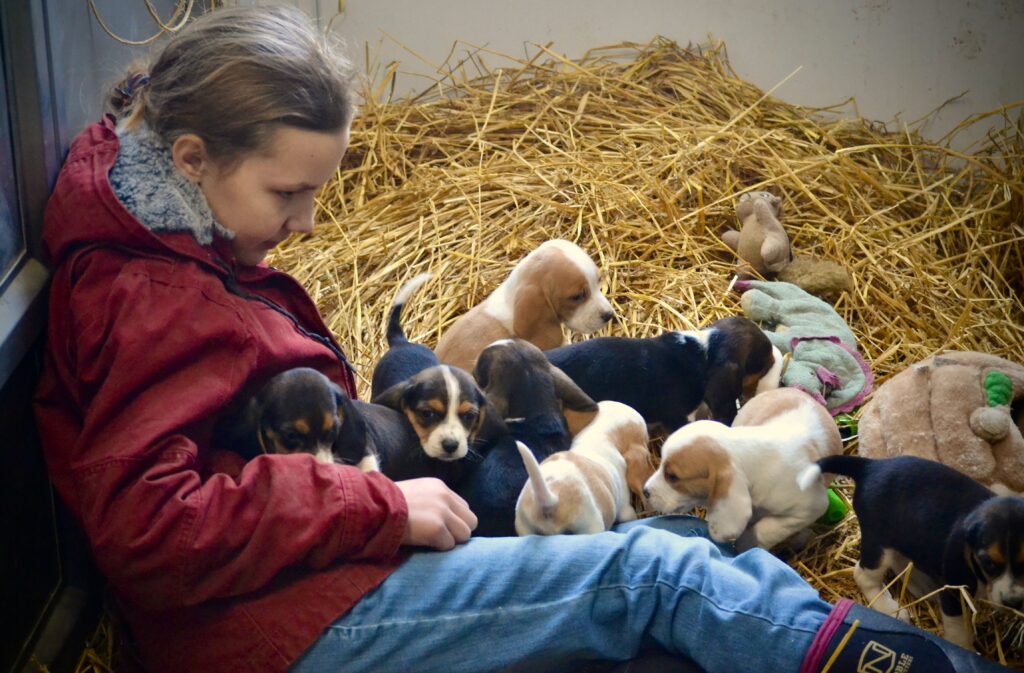
Pups that have had ENS conditioning are shown to handle stress far better than pups that have not. If you’re a breeder, then consider adding ENS to your post-whelping days. If you’re getting a pup from a breeder then see if they’ll add it to their program.
The next important foundational phase begins around the four-week mark and involves socialization. This process is controlled and introduces the pup to normal sounds, sights, and places where he’ll live, work, eat, and sleep. Around the six-week mark he’ll be confident with that initial socialization, and taking pup into more public areas is the next step. There he’ll hear and see vehicles and commotion, encounter sharp, loud sounds coming from the closing of vehicle doors, beeping horns, and the like. Keep exposure times short and safe; for instance, walking a pup on a lead in a calm, small town center will provide the kind of exposure you’re looking for versus a trip to a major sporting event. The goal is to further develop a pup’s confidence through proper socialization. Slow and steady wins the race.
Then, add in a variety of loud, sudden noises while pup is doing something enjoyable. Clap your hands while pup walks around a pen or a room. Clap together a pair of dog bowls while he’s eating. If a sharp clang of a metal spoon on a metal pot causes pup to stop eating and look up at you, don’t look back. He’s reading your signs as you read his, and if you look concerned, he’ll pick up on that. When pup returns to eating, add an additional clang at random intervals. Slapping together two pieces of wood or popping a paper bag are similar to a gunshot but keep all sounds normal. You’re building a foundation for a proper introduction to gunfire and not trying to resemble either Col Hatchman or John Bonham pounding the Zildjians and skins.
A few other good practices include slamming a cabinet door while getting pup a bone or a treat, playing a variety of loud music, setting an alarm to suddenly sound, work well, too. Just make sure that they’re progressive and that pup responds positively to them before raising the sound levels.
Step-By-Step Gunfire Introduction
When your pup shows confidence around a variety of loud, sharp noises, you’re ready to introduce him to the gun. Head outside where the sound will dissipate and use a pellet gun, a BB gun, or a starter pistol. Discharge the firearm when the puppy is doing something pleasurable like running in the woods or retrieving a bumper, and do so when he’s at a distance. As the pup shows confidence with the noise, shorten the distance so you’re closer to him. Be sure the noise is secondary and that the fun activity of running or retrieving is primary.

The final step is to introduce your pup to the gun when a bird or dummy is used. For pointing breeds, set a launcher with a pigeon, and attach a check cord to your pup. Staunch him up and add some distance between you and your pup. Launch the bird and when the pup moves, fire the starter pistol in the direction opposite. For retrievers, introduce your pup after he’s retrieving well. Position yourself a distance away from him and throw a bumper. When the bumper is in the air, discharge your starter pistol. When the bumper lands send pup on a retrieve.
Gauge your pup’s response by reading his signs. If he’s alert, ready to go with bright eyes, a cracking tail and ears that are forward, keep going. Back off if he’s tucking his tail under his legs, is shaking, has ears pulled back, or crouches low to the ground. Your goal is to build confidence, not undermine it, so avoid these concepts at all costs:
- Don’t take your pup to a gun range. Some folks swear by leaving a pup in a kennel at the skeet range, but others have made pups gun shy for life. It’s a coin toss for sure, and with only 50% odds, it’s best to avoid.
- When using shotguns, start with a smaller gauge like a 28 or a .410 and progressively work your way to larger bores as he shows confidence.
- Don’t test fire around a puppy. If your puppy wasn’t gun shy before you pulled the trigger, there’s a good chance he is now.
- Don’t take a dog hunting without first introducing him to the gun. If you do, you’ll be sitting next to me at the bar.
- Older dogs teach younger dogs a lot of things. Confidence to a gun shot isn’t one of them.
Puppies aren’t born gun shy; improper exposure makes them that way. It’s very difficult—if not impossible—to retrain a gun-shy puppy, so why take the chance? Build a foundation, get pup some experience, and take your time.